The Great Upheaval at the AGO until March 2, 2014

Andrea Wrobel, Senior Staff Writer

From now until March 2nd at the Art Gallery of Ontario, patrons can view The Great Upheaval: Masterpieces from the Guggenheim Collection, 1910-1918, a collection of dynamic, expressionist, and innovative art from the likes of Picasso, Delaunay, Kupka, Matisse, and many more incredible artists!


The Great Upheaval occurred from 1910 to 1918. It was a time of turmoil leading up to and reflecting World War I which began in 1914, lasting until 1918. The art that has come to represent this period reflects both the excitement and anxieties of the individuals who experience these turbulent years. Termed by Russian pioneer Vasily Kandinsky, the controversial work of Cezanne and Gaugin sparked this "Great Upheaval," and at the AGO, we are brought through a truly visual revolution.

Along with Cezanne and Gaugin, visitors can bask in the brush stroked of Picasso, Seurat, Kandinsky, Matisse, Chagall, Delaunay, Kupka, and more. Their presence and expression begs me to list them all, but it's just as safe you go see for yourself.

"The Football Players,"
Rousseau (1909)
Never formally trained as an artist, Rousseau painted a portrait-like piece called "The Football Players" in 1909 (left).  With this piece he defied traditional practices with its illogical scale - the size of the trees versus the size of the subjects - and the subjects themselves look as though they're posing rather than playing.

This defiance of traditional practices is seen in many of the pieces. Kandinsky, for example, used bright colours in his landscape pieces; the hills, skies, and mountains still ominous and recognizable but with blues, purples, and reds instead of greens, browns, and greys.  We begin to see artists using colour to express an alternate reality; an abstraction that was so new and foreign at the time. Over time the "real world" disappears completely from Kandinsky's work; a possible representation of the brisk industrialization of social culture.

"Eiffel Tower with Trees,"
Delauney (1910)
Kupka used non-traditional colour planes to expose depth while others used geometric shapes to create the illusion of flattened spaces.  The exhibit sheds light on Delaunay's destructive phase: dark lines and shadows depict a deconstructed Eiffel Tower in "Eiffel Tower with Trees" (1910).  The tower became a symbol of modernity for the artist.  It is here we begin to see Cubism emerge - the breaking down of form and space.

There was a move away from materialism toward a more spiritualistic perception.  Two manifestos were signed by many of the artists in 1910 to promote Futurism, an artistic and literacy movement embracing modern life. A group called Der Blaue Reiter (The Blue Rider, 1911-1914) was co-founded by a group of artists, Kandinsky being one, and they committed themselves to the externalizing of this internal paradigm shift.

"The Italian Woman,"
Matisse (1916)
"Intoxicated Man,"
Magnelli (1918)
When the war began in 1914, the artists entered with optimism but awoke to its true horrors.  For some artists, the subjects transformed into this darkness and, for others, their colours.  The backgrounds envelope the foregrounds and abstraction and anguish are ever-so-present.  On a massively accepted level, the artists of The Great Upheaval lead painting and, more generally, art expression away from a pure reflection of the world and into a more pure reflection of the inner soul.


Happy February the 14th to you, your dreams, and that person beside you!


Wishing you a happy Friday. TGIF.


#LOVELOCAL this weekend:


The 35th Rhubarb Festival to taunt and tease Buddies in Bad Times Theatre Feb. 12-23

The 35th Annual Rhubarb Festival is kicking off in Toronto's Church/Wellesley Village February 12th, running until the 23rd, 2014. Over 100 artists will transform Buddies in Bad Times Theatre and local hotspots with contemporary theatre, dance, music, and performance art. We spoke to festival director Laura Nanni about experimental works, the fusion of music and theatre, and how the festival mingles with the community and its audiences.

Henri Faberge and Humboldt Magnussen; Photo by Tanja-Tiziana
Laura Nanni; Photo by Tanja-Tiziana
In her fourth year as festival director, Laura Nanni, pictured at right, is excitedly awaiting to bring this years artist program to Rhubarb's adventure-loving audience. With her roots as a producer and curator, Nanni encourages the creation of new work at Rhubarb, especially those that push the boundaries of what performance can be. She asks artists to think outside the box.

"If you look back to really early Rhubarbs," Nanni explained, "it's always encouraged a mix of disciplines, where a painter could be a playwright, for example. At Rhubarb, you can see non-performers or people trying something for the first time."

Nanni said they ask artists to explore their own curiosities and how they can explore them through new territory. One way Rhubarb is exhibiting these projects are through "open space calls" where artists are bringing their work into places like the 519 Church Street Community Centre, the Canadian Lesbian + Gay Archives, and Pink Triangle Press.

Nanni said audiences are going to see a lot of musical artists working in new ways this year.

"With Regina the Gentlelady, it's the first time they’ve created a one woman show where it’s more text based and narrative rather than the music driving the piece," Nanni said.  "Musicians are really looking at the intersection between narrative, performance, and music. Experimenting with the form of the 'concert' in relation to theatre."

But music is only one part of this week-long extravaganza in unique and transformative work.

Heather Cassils; Photo by Manual Vason
"Rhubarb is programmed in a way that you’re meant to not see just one show – it’s a full night. If you come, you come for a whole evening of multiple performances." Nanni said, adding that, if you're only going to come for one evening, "I would recommend opening night and that is because you’ll get a really good taste of the festival."

Rhubarb is trying to change the culture of how work is viewed, Nanni explained. "Every year there are new audience members that come to the festival, but there’s also a really dedicated audience that come to see things that could completely blow their mind.  Audiences aren't coming to judge, they’re coming to be a part of the experience."

Nanni promises the festival is going to "as loud and as boundary pushing as ever!" Opening night brings trained bodybuilder and performance artist Heather Cassils, pictured above. Cassils' work actively challenges perceptions of gender, pushing the physical body to its extreme limits. There will also be events in five spaces including the board room and dressing room at Buddies, live podcast recordings, and shows in the cabaret, if that gives you an idea of how busy a night at Rhubarb can be! The list of talented individuals involved would go on and on, so, for the whole festival schedule, click here.

The Rhubarb Festival is the oldest festival in Canada dedicated to new work.

While many events are free or PWYC, evenings requiring tickets are $10 for week one events, and $20 for week two events. You can get them at Buddies Box Office!

Bridget Moser for Jagged Canyons - the story of two sisters who were once friends, now enemies.


Article by Andrea Wrobel


The Photography of Ali Eisner

Ali Eisner's iconic photo of The Flash sitting in an LA Diner.

When I meet Ali Eisner I feel like I already know her. I've been wandering around her exhibition at The Gladstone Hotel for about an hour, looking at the vast array of photos that comprise her show Favourite Things.

Sometimes, when starring at photography works it can be hard to get a sense of the artists, but not with Ali. The photos in this exhibit cover a wide range of subjects, from musicians to urban landscapes to superheroes in diners to inanimate objects. And, when I finally get talking with Ali after the show, she confirms just about every positive feeling I have about her and her work.

The iconic sign above Honest Ed's.
Ali started her photography practice at a young age, essentially growing up in a darkroom. Her father worked in the camera shop at Honnest Ed's where her parents met. Starting with the use of film and darkrooms has been a major influence as Ali's work has moved to digital. She says she tries not to abuse the use of digital and overshoot, "I try to take my time with stuff and be in the moment.” This patience is evident in Ali's many shots of musician friends. You can tell she just waited for that "right moment."

The Flash sunbathing.
Hilariously, sometimes her photography is a bi-product of making moments happen. The photo above, The Flash, was taken in LA when Ali and her partner Christine missed Halloween. The two had their costumes planned and packed, but when Christine got sick on Halloween their plans to go out as The Flash and Batman were ruined. So, later, Ali decided they would dress up and take photos. Christine is pictured here in a sun-bathing, while Ali is behind the camera; yes, dressed as Batman.

Ron Sexsmith playing an intimate show.
Ali is also very physical with her photography, favouring a fixed lense with no zoom. “I really got used to having to compose my shots using my body.” While a courageous move that forces her to interact with her subjects, being 5'3" means that "getting close" can often be a hassle. “The tallest guy in the stadium will somehow find his way in front of me,” she says while laughing.

Gimmie an R! by Ali Eisner.
None-the-less, the use of fixed lenses definitely creates an intimacy that is apparent. Her piece, Gimmie an R! spoke to me at the show, and when I asked Ali about it the reasons were clear. She says the shot was from Douglas Coupland's exhibition Atelier - a very colourful show involving kids toy blocks spelling very "adult" words. Oddly, I found the piece sad and reverent, both because of its lack of colour, but also because of its focus. Ali confirms that she trusted her instincts when focusing solely on one letter, rather than the entire word, and that the choice to change the photo from colour to black and white was deliberate. "It’s not how I was feeling in that moment,"  she tells me,  "It was a happy moment but I decided to see another side of it."

Trusting your instincts is an important part of being an artist and something Ali does quite well. Beyond being a photographer, she is also a puppeteer and musician. Ali recently retired from the role of CBC's Mama Yamma and still plays Jay the Blue Jay on TVO Kids' Gisele's Big Back Yard. She says that acting is about making moments happen, while being a photographer is about watching and waiting for those moments to happen. She says that photography helps her find balance in being an actor and that the energy of one bleeds into another. “It’s important for me to do quiet stuff,” she says.

While Favourite Things is over at The Gladstone, Ali has alluded to many exciting new projects in the future. In the meantime, check out many more of Ali's photos here.

Article by Brian Cauley.

Toronto Design Offsite Festival 2014


The Toronto Design Offsite Festival is an event that I look forward to every year. You get design. You get art. You get art about design and design about art—basically, if you enjoy art or design in any capacity, even if only during an annual, drunken stumble through Nuit Blanche, TO DO will have something for you. On top of all that, most of the exhibitions are either free or very affordable and feature a mix of established and emerging artists who engage with a diverse set of themes in eclectic settings. Here are some of the events I'm looking forward to this year:

Come Up to My Room

Photo: Come Up To My Room
Although it's not really billed this way, Come Up to My Room feels like one of the gala expositions of TO DO, and it's a personal favourite. This year, artists and designers will take over the Gladstone Hotel with installations and "unexpected prototypes" that engage with themes of "trust, risk, and collaboration." You can see and hear some of the exhibitors talk about their works in progress on the CUTMR website. It's a steal at $10 ($5 for students).

From Nothing, Something


A documentary about the creative process screening for one night only at the Bloor Hot Docs Cinema. If you've ever wrestled with the wacky alchemy of designing, drawing, writing, coding, building, making (hopefully) awesome stuff, this might be for you. Plus, the Bloor is great. Any excuse to drink beer in a movie theatre is fine with me.

Eames: the Architect and the Painter


I have a strange fascination with couples who manage to work, play, and live together. In this documentary, the couple in question is Charles and Ray Eames, two of the most influential design thinker/practitioners of the last century. If you had a chance to see the film about the Vignelli's last year at Hot Docs, this will be an interesting counterpoint.

Digital Promises

Photo: TO DO

If, like me, talk of 3D printers and their potential for revolutionizing our material and social worlds sets your imagination alight with possibilities of self-manufacturing robots, "printed" limbs, and Star Trek-esque food replicators, you might want to see this show.


Nations are Narrations

Photo: Nicole Tarasick

Maps are very "in" right now. We seem to be living through a period where people, especially urbanites, renegotiate their relationships with the built environments they live in. I enjoy placemaking in its many forms, from urban art installations like TO's own murmur to the Leslieville toque I got for Christmas. This exhibition by Nicole Tarasick, one of the designers behind STYLEGARAGE, is a series of prints on a 1957 Atlas of Canada.

The festival runs next week (January 20th to 24th) at venues all over downtown. 


By Justin

Toronto's own Krista Bridge on her book and getting published

Torontonian and writer Krista Bridge is gearing up for a big year after being a featured writer at the 2013 International Festival of Authors (IFOA) at the Harbourfront Centre. Check out a bit of what she has to say about private schools, writing in Toronto, and what to do if you're looking to get your work out into the world.


What was your part in 2013's IFOA?

I felt very lucky to be invited to the IFOA this year. Although I’ve done the Harbourfront weekly reading series before, I’ve never been part of the IFOA, and I’m amazed to realize what a huge festival it is. It’s been fantastic to connect with readers who want to read my book or those who’ve read it already. This year I was part of two IFOA Ontario events: one in Woodstock, one in Midland. The audiences there were so warm and enthusiastic. They really know how to welcome writers. In Woodstock, I met someone who just got my book so completely I doubt I’ll ever forget her.

How do you feel the IFOA has changed and/or influenced your position as an author?

Just to be included in the company of so many writers I admire is energizing and inspiring. And IFOA has given me an opportunity to reach so many more readers.

What encourages or drives you to write stories like 'The Eliot Girls'?

Writing is a compulsion for me. I do it more or less every day, including weekends, when I’m able, and when I don’t do it, I feel more irritable, more restless, just in general less like myself. With The Eliot Girls, I wanted to shed some small light on the petty and often limited lives we lead. I was interested in the private school setting because it’s one I know well, having spent my formative years at private schools—although the novel is in fact not autobiographical. I knew that a private school would make a rich setting for a novel because those schools are sort of worlds unto themselves. I was interested in the politics of private schools, the psychological warfare girls wage on each other. I wanted the explore the hypocrisy of this school’s values—it’s so busy creating myths of itself that it’s disconnected from what actually goes on inside it. Ultimately, it’s a story of our struggle to learn how to live.

Has Toronto been helpful to you as a writer? 

I wouldn’t say Toronto has been helpful exactly, but it’s a part of me, sort of in the same way my family is a part of me. Toronto forms the landscape of my memory. It didn’t make its presence felt much in my early writing, but I’m growing more interested in creating a place on the page, so there are Toronto locations mentioned in my novel The Eliot Girls. And in my next book, though I’m still just beginning, I expect that more of the Toronto I know will come out on the page. I like the idea of writers making readers see places they know in a new way.

Do you have any advice for emerging writers?

One of the best things emerging writers can probably do is to submit their stories to lots of literary journals and to try not to take the rejections too personally. For me, it was great to have a small writers groups, just four of us, and we met each week and read our stories aloud to each other and gave each other feedback. It was essential to me, especially at that stage in my writing life, to have friends/readers whom I trusted. I met my group in a creative writing class at the University of Toronto’s School of Continuing Studies. I also took the Humber School for Writers Correspondence Course, and that was essential for me. I was paired with Elisabeth Harvor, and her support of my writing changed my life.

What's next for Krista Bridge?

I’m working on my next novel. It’s still in the early stages, so I can’t say much about it, but it’s set in Toronto.

Article by Andrea Wrobel.

Local puppetter Ali Eisner delves into photography


Have you ever caught episodes of CBC's Mamma Yamma and wondered who could possibly be behind such a puppet? It's local artist of many talents, Ali Eisner. Eisner's website totes her as an "award winning Puppeteer, Writer, Composer, Singer/Songwriter, Photographer and Director for Children’s Television" and now she's on to photography.

In her debut photography exhibit, Favourite Things, currently on show at the Gladstone Hotel, Eisner is sharing some of her favourite images; images bound to astound, inspire, and shed some light on what it's like to lead such a creative life.


From now until January 19th, 2014, you can see Favourite Things at the Gladstone Hotel, 1214 Queen Street West.

Check out the information below or the Facebook event for exact details.

Running January 3rd to January 19th, 2014

Exhibition Hours: 12pm to 5pm daily 
Opening Reception: Jan 9th, 2014, 7 to 10pm

Follow Ali on Twitter or check out her website!

A Room of One's Own at Campbell House Museum

“I like to imagine that Shakespeare had a sister,” she said, “whose genius was for fiction.” She lust for it. It consumed her. She needed it and it needed her, but she was banned from bonding with it because she was a woman.


This is Virginia Woolf - or, in our case, Naomi Wright.  Wright is co-founder of the Bloomsbury Collective, an equity co-op presenting Virginia Woolf’s A Room of One’s Own at the Campbell House Museum this until November 24th, 2013. Along with director and co-founder Sarah Rodgers, the all female cast and crew came together to explore the state of equality for women in today’s world, just as Woolf did back in 1928 when the play is set.

It must be mentioned that Wright and Rodgers did not intend the all female line up.

“We didn’t say that since this is Virgina Woolf...we must be all women,” Wright explained, adding that after asking the internet where women in the arts presently stood, she came across a study that begged attention. The woman conducting research, a professor out of Princeton, noted that 80% of the plays produced in the US are written by men. The gave her the idea to send out the same script, one authored by a man’s name and the other authored by a female name, to various agents across the US.  The outcome shocked Wright.

“She found that the female scrips got a more negative review from the female literary directors and agents,” Wright explained. “Basically saying that the female script was weaker. It’s a very disturbing thought that someone women tend to be harder on other women.”

This was what encouraged Wright and Rodger’s decision to choose all women.  They wanted this project to be about women recognizing and working with other women who were not only talented, but passionate about similar mediums.

The play - A Room of One’s Own - was adapted for the stage in 1986 by Patrick Garland.  Falling in love with the piece over 10 years ago when Rodgers brought it to her attention, Wright found Woolf’s words so “exquisitely moving” she couldn’t let it go.

“I can sometimes get really tongue-tied and can’t put my finger on a word but Virginia Woolf is so elegant,” Wright boasted. “It’s kind of like speaking Shakespeare. The way she spins sentences and the way she spins thoughts is extremely satisfying as a director and actor.”

“She’s a really complicated woman, too, which has been really fascinating. I wish I had time to read every biography.”

Wright describes that, for all Woolf was outspoken and opinionated about, she was actually quite a sensitive person.

“Virginia was really susceptive to criticism. She was so shy and very reserved,” Wright said. “When people were critical of her work and appearance, it hurt her deeply.”

That feeling and vulnerability is threaded in A Room of One’s Own and Wright does a fasniating job of portraying it.

Guests have the opportunity to peruse the Campbell House, as well as Woolf’s diary and personal letters that offer a glimpse into Woolf’s internal life.

Exploring topics of gender in literature in life, Wright as Woolf abandons her speech - the one she is giving in the play - to more anecdotal and opinionated views. ‘How unpleasant it is to be locked out,’ she proclaims, referring to Woolf’s inability to enter a library as a public person; as a woman.

Possibly the most poignant tie in to women as writers and characters in literature is the fictional sister of Shakespeare that Woolf tells us about. She uses the idea to discern that trying to define one sex as distinct from the other blatantly interferes with the unity of the mind.  Doing this has resulted in the representation of women - profound in literature, property in real life.

Wright’s ability to naturalize Woolf’s words is impeccable and overpowering. Woolf’s words still sting with importance in today’s world; it’s staggering to hear the thoughts of such a revolutionary as though she is standing in front of you, telling you that history does not have to repeat itself. We have the ability to change it.

“It’s fatal to think of sex when writing,” she said. “It’s much more important to be oneself than anyone else.”


--

With a ticket, guests have access to the museum library for the entire run of the show.

Location:         The Campbell House Museum
Date:                 November 13 - 24
                           Wednesday - Saturday, 7:00 pm
                           Sunday, 2pm

Cost:                 $20 – Light refreshments. Cash bar.
Tickets:            brownpapertickets and Campbell House Box Office at 416.597.0227 ext 2

To learn more, please visit: aroomofonesown.ca
Get social: @roomofonesownTO facebook.com/aroomofonesown

Photos by Brian Cauley
Article brought to you by Andrea Wrobel

Virginia Woolf visits the Campbell House Museum (almost literally)

Welcome to 1928.  You're at Girton Women's College and tonight's the night Virginia Woolf is going to speak. There's light music, you've had a couple drinks, you've just read an excellent excerpt from a classic novel whose home is in the library, and your mind is thriving in this enchanted atmosphere.  You're hearing true anecdotes and written stories from Virgina herself. She's talking about women - women as writers and women as characters in the stories they possess.  It's all very surreal; important. It's going to influence history in ways you can not even imagine.


Naomi Wright as Virginia Woolf
Photo courtesy of Bloomsbury Collective

From now until November 24th, 2013, guests are invited to experience Bloomsbury Collective's premiere of Virginia Woolf's A Room of One's Own at the Campbell House Museum

Set in 1928, the all female cast and crew present Woolf's iconic work as an immersive and surely unforgettable theatrical production.  Guests can explore the library, read newspapers from 1928, and discover the political and sociological temperature of the era while perusing Campbell House Museum and Virginia Woolf's quarters where one can peek at her letters and diary.

With a ticket, guests have access to the museum library for the entire run of the show.

Location:         The Campbell House Museum
Date:                 November 13 - 24
                           Wednesday - Saturday, 7:00 pm
                           Sunday, 2pm

Cost:                 $20 – Light refreshments. Cash bar.
Tickets:            brownpapertickets and Campbell House Box Office at 416.597.0227 ext 2

To learn more, please visit: aroomofonesown.ca
Get social: @roomofonesownTO facebook.com/aroomofonesown

Brought to you by Andrea Wrobel

The Toronto Island Ghost Hole

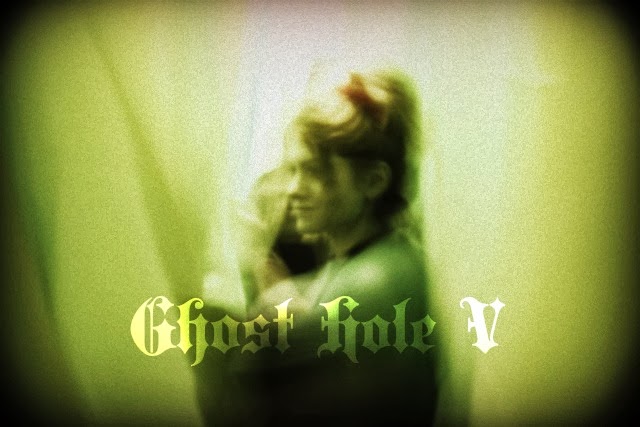
Were you lucky enough to board the Ghost Ship over to Toronto Island's Artscape Gibraltar Point on October 26th? Here's only a little bit of what you missed out on if you didn't board the boat to Ghost Hole V (we couldn't bare to capture it all)!


THE GOULISH HUNT CLUB
THE LIBRARY
THE BAR
THE BEACH
To give you more info on what happened in the incredibly spooky hallways of the old school t
urned zombie (artist) residency, and to learn the GHOST HOLE GHOST HOLE Chant, bet you can't click play below:


Leisurely peruse the rest of our Ghost Hole photos here (IF YOU DARE):
 

Video by Brian Cauley
Photos by Andrea Wrobel

International Festival of Authors (IFOA) visits Toronto's Harbourfront Centre

The written word - an element that unavoidably crosses our paths almost constantly. This year the International Festival of Authors, or the IFOA for short, is turning the spotlight on the written words of young and emerging authors exploring multiple genres, from memoir to thriller.  Brave New World is the focus and it's running from Saturday, October 26th through Sunday, November 3rd at Toronto's Harbourfront Centre.

Each fall, the International Festival of Authors brings together the world’s best writers of contemporary literature for 11 days of readings, interviews, lectures, round table discussions, public book signings and a number of special events, including readings by Governor General’s Literary Awards and Rogers Writers’ Trust Fiction Prize finalists, as well as the awarding of the Harbourfront Festival Prize. - IFOA.ORG

Here are some of the writers we're looking forward to hearing from:

Krista Bridge (Canada)
Krista Bridge is the author of The Virgin Spy, which was shortlisted for the Danuta Gleed Literary Award and the ReLit Award. She has been published in Toronto Life, Descant, Prism International and Prairie Fire. Her short fiction has been nominated for a National Magazine Award, and one of her stories was selected for the Journey Prize Anthology. Bridge presents her new novel, the Rogers Writers’ Trust-shortlisted, The Eliot Girls, about a fictional all-girls private school in Toronto. When Audrey Brindle, who has dreamed of attending for years, is finally admitted, she discovers that it is a place of betrayal, cruelty and injustice. - IFOA.ORG


Eleanor Catton (Canada , New Zealand)
Eleanor Catton was born in 1985 in London, Ontario and raised in Christchurch, New Zealand. Her debut novel, The Rehearsal, won the Amazon.ca First Novel Award, the Betty Trask Prize and the NZSA Hubert Church Best First Book Award for Fiction. In 2010, she was awarded the New Zealand Arts Foundation New Generation Award. Catton presents her second novel, The Luminaries, winner of the 2013 Man Booker Prize and shortlisted for  the Governor General’s Literary Award for English Fiction. Set in 1866 during New Zealand’s gold rush, this richly imagined story weaves together the fates and fortunes of an entire community, where everyone has something to hide. - IFOA.ORG


Shani Boianjiu (Israel)
Shani Boianjiu was chosen by author Nicole Krauss as one of the National Book Foundation’s “5 Under 35” award winners. At the age of 18, she entered the Israel Defence Forces, and at 26, she is one of the youngest writers on Random House of Canada’s prestigious Bond Street Books list. Boianjiu will present her debut novel, The People of Forever Are Not Afraid, about young women in the Israel Defence Forces. Constantly preparing for a moment that may never arrive, they are perpetually waiting—for womanhood, orders, war, peace. - IFOA.ORG


Elizabeth Hay (Canada)
Elizabeth Hay is the author of the Scotiabank Giller Prize-winning novel Late Nights On Air, as well as three other award-winning works of fiction, Small Change, A Student of Weather and Garbo Laughs. Formerly a radio broadcaster, she has spent time in Mexico and New York City, and now lives in Ottawa. - IFOA.ORG


The IFOA plays a crucial role in Canadian culture, providing an international audience for the work of Canadian writers. Established in 1986, it's one of the oldest divisions of Harbourfront Centre's Literary Arts department. Programming runs from September to June with the international festival on annually, in October.

Direct from the IFOA Brave New World website, the schedule of incredible events for Brave New World is below. 

Tickets range from FREE to $18 and all events are free to students and those under 25 years of age.

See you there!

Saturday, October 26
Sunday, October 27
Tuesday, October 29
Wednesday, October 30
Thursday, October 31
Saturday, November 2
Sunday, November 3

Brought to you by Andrea Wrobel

Canzine Awesomeness

I attended my first Canzine this past weekend. Needless to say, I was very impressed. To an outsider, Zine-dom seems like a great place. The big, timbered a-frame of the 918 Bathurst Center was crammed with open-minded, open-hearted people eager to meet new people and talk openly about the wonderful things they've made. And most of the stuff on display was incredible. Almost every table enticed me with things both interesting and beautifully made.  I walked out with a great mix of zines, chapbooks, magazines, and graphic novels from Toronto and elsewhere. Here are some of the highlights in no particular order:

Zanta: The Living Legend by Jason Kiefer

A graphic biography of a local legend: Zanta, a santa-hat-wearing street performer whose topless, bare-knuckle pushups have gotten him banned from the entire downtown core of Toronto.


The City the Night Before by Coco Riot Guzman

A short, house-shaped zine with beautiful illustration about the citizens of a city on the night before a revolution erupts.


The Life and Times of Butch Dykes: Judith Butler by B&D Press

Anyone who has been to grad school and/or done any gender studies will appreciate this one; a cheeky little biography of an inspiring thinker.


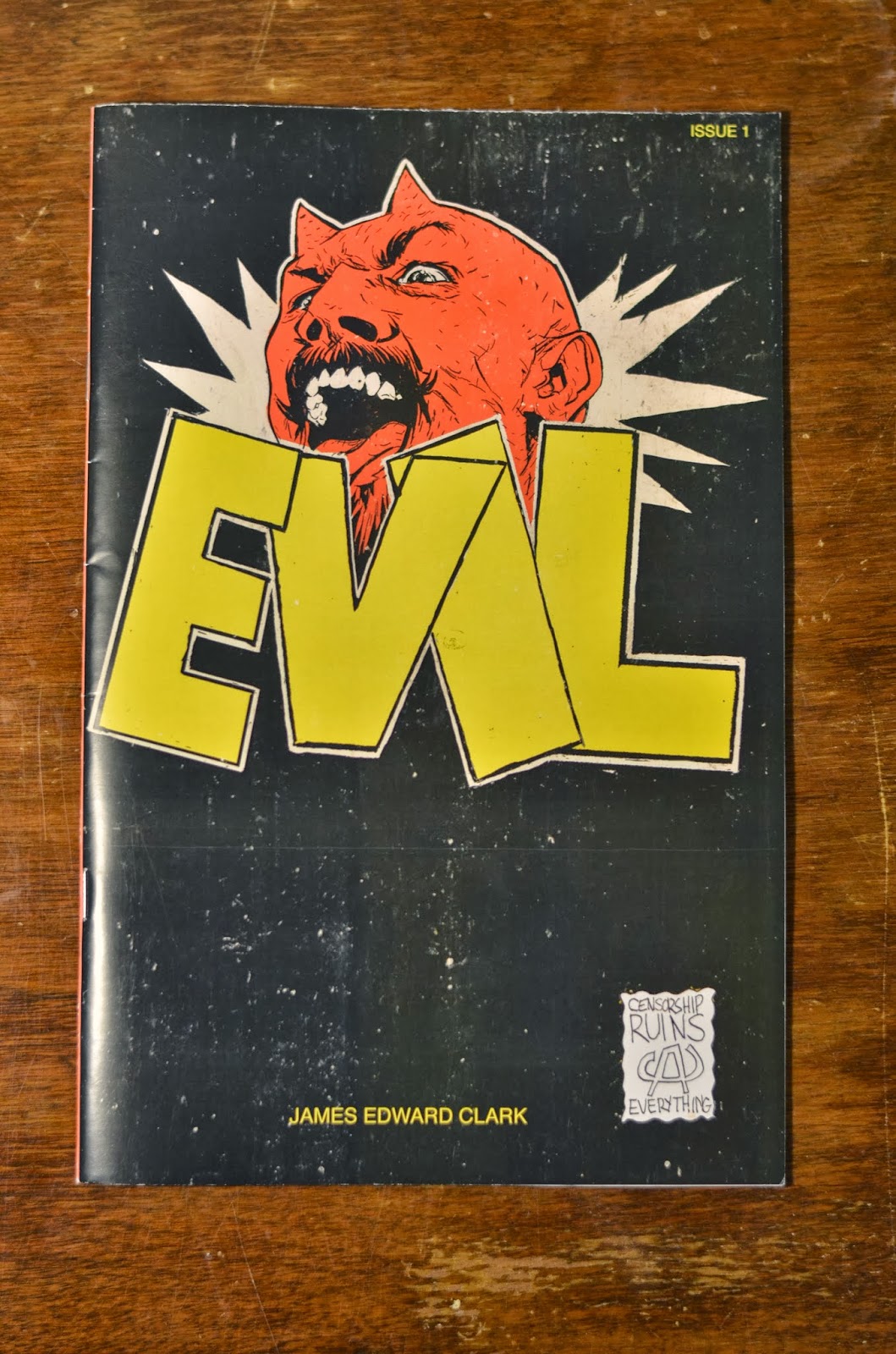
Evil by James Edward Clark

This wacky comic has some incredible artwork and a plot line which features, among other things, demon motorcycle gangs, fire pistols, and a storyline where Rasputin and Charles Manson meet in jail and become lovers.


A relative newcomer to the Toronto magazine community, great art direction and an eclectic mix of photo essays, prose, and poetry set Little Brother apart. 


Post by Justin